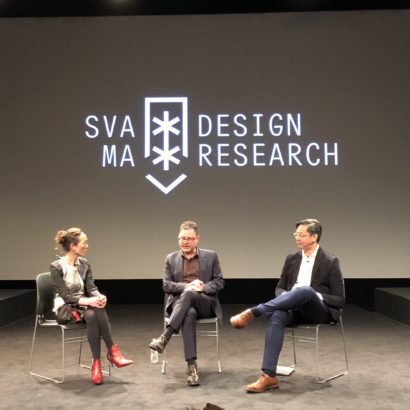
Later this year here in New York, the School of Visual Arts will debut a new, two-year Master of Fine Arts program in Design Criticism. The program promises to train students “to research, analyze, and evaluate design and its social and environmental implications,” and boasts a faculty roster that includes many of the sharpest minds writing about and working in design today.
In spite of my general aversion to academia, I must admit that I’m pretty excited about this. Don’t get me wrong; I have no objection to scholarly pursuits. There’s just something about academia that usually fails to get me as worked up as I feel like it should. But D-Crit, as the program has colloquially named itself, has the potential not just to turn out stellar practitioners, but also to elevate a sorely underdeveloped aspect of our craft. Design has gained much traction over the past several decades, but the way we think and write about design has a long way to go, it seems to me.
The chair of the D-Crit program is the prolific Alice Twemlow, who has written far and wide about design and over the past several years has had a rapidly growing reputation and influence as one of the profession’s key critics and thinkers. She also happens to be a friend of mine, so I took advantage of that fact to conduct a brief interview with her here, trying to get a better idea of her ambitions for the program as it readies itself for a fall kickoff.
(Another note: in advance of that kickoff, D-Crit has been organizing a series of readings in New York City, previewing some of the writing and works from faculty. The next one takes place this coming Thursday, at KGB Bar in New York’s East Village, and focuses on the intersection of design and food. I’ll be there.)
Continue Reading …
+
 Hurray for the
  Most of you reading this probably have only a few days left, at most, to go see what in my opinion will surely prove to be one of the most underrated films of the recent past — before it’s withdrawn from your local multiplexes entirely due to its almost universally