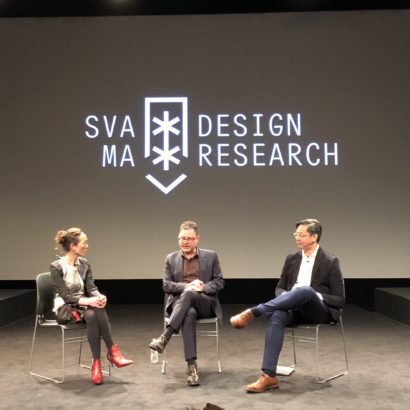
Post-panel

Liz Danzico, Mark Boulton, Toni Greaves, Jason Santa Maria and I have just finished our panel, “Traditional Design and New Technology” here at this year’s South by Southwest Interactive Festival. Frankly, I’m relieved; we spent a lot of time preparing for it, including an endless stream of email exchanges, many outline drafts, international conference calls, and a big, team-building breakfast here in Austin at 7:30a this morning, so there was a lot of build-up. In the end, I think the panel went pretty well — basically, anything that went well is owing to Liz Danzico’s masterful job of moderating the discussion. We had a pretty lively debate and several challenging questions from the audience; the festival management has recorded it, apparently, and will be posting a podcast sometime soon, which I’ll link to when I find it. Anyway, I enjoyed the whole experience quite a lot. If you were in the audience today, first, thanks for attending, and second, I’d be keen to know what you thought. Don’t be shy, I can take it.

Continue Reading

+

The Elements of Style Manuals, Part Two

Wow, I’m a little stunned by the general lack of reaction to Monday’s post about the long decline in the quality of design style manuals. Maybe I was under some hallucination that this is an issue that many (if not most) designers will encounter many times in their careers, and that those designers would generally find the tortured motivations of style manuals to be a worrying state of affairs. Even so, it was one of my favorite pieces so far; I took out more time to write it than I do most pieces, and I think it represents a novel perspective on what it is exactly that designers deliver to clients.

At any rate, I’m undeterred in my pursuit of this subject. Never let it be said that I’m guided solely by comment count! As it happens, the second part of my rant on this subject is considerably less ambitious — it works off of the premise that the climate of client-designer expectations is one that’s unlikely to change anytime soon. For the time being, designers are stuck with these particular circumstances when it comes to style manuals: a high bar for comprehensiveness and a low threshold for time and for fees devoted to documentation — resulting in a lot of labor producing little value.

Continue Reading

+

Odds and Ends

Traditional Design & New TechnologyI don’t often write ‘round up-style’ write weblog posts, but I’ve got a crazy week this week, so I’m going to make an exception. Most of the craziness is the fault of my coming trip to Austin, TX to attend this year’s South by Southwest Interactive Festival; I’m just running around trying to take care of everything before I go. For those of you attending, please see me come talk out of my butt on Saturday morning at 10:00a, when I’ll be participating in a panel called “Traditional Design &amp New Technology.” It’s in an early time slot, but I promise you, I’ll be glad you made it there. And you might learn something!

Continue Reading

+

The Elements of Style Manuals, Part One

It strikes me that there are lots of problems with style manuals, those definitive pieces of documentation that accompany a completed design solution: Clients want them to be a comprehensive set of full-contigency bylaws governing the usage of the designs they’ve paid for, but they frequently balk at the necessary time and expense that’s necessary to produce anything so complete. Designers want to deliver a sound set of pliable guidelines that will continue to do justice to their work, but even with a capacious budget, they can’t possibly provide enough all-encompassing logic to stand in for design talent absent from a client’s payroll.

These conflicting circumstances usually result in style manuals full of what I like to call ‘rote specifications’; thick booklets packed with granular details on sizes, measurements, colors and rudimentary “do’s and don’ts” for the usage of a design solution. Unfortunately, these are usually constructed to appearimpressive above all else, relying on the sheer quantity of detail to justify to clients both the full expense of the design process and to evince the apparent sustainability of the completed design.

At best, they’re superficial documents with limited usefulness; like blueprints for television homes, they’re interesting in their intricacy, but of limited practical value in real life. I’ve seen many style manuals that, while voluminous, were useful for only a handful of factual attributes: PANTONE colors, typeface specifications, and grid measurements, for instance, but little else. One could have easily been reduced these manuals to a handful of pages and they would have proven just as useful.

Continue Reading

+