is a blog about design, technology and culture written by Khoi Vinh, and has been more or less continuously published since December 2000 in New York City. Khoi is currently Principal Designer at Adobe. Previously, Khoi was co-founder and CEO of Mixel (acquired in 2013), Design Director of The New York Times Online, and co-founder of the design studio Behavior, LLC. He is the author of “How They Got There: Interviews with Digital Designers About Their Careers”and “Ordering Disorder: Grid Principles for Web Design,” and was named one of Fast Company’s “fifty most influential designers in America.” Khoi lives in Crown Heights, Brooklyn with his wife and three children.
Free presentation aid for Mac OS X “dims the screen and puts a spotlight on the area around the mouse pointer, easily guiding the audience’s attention or to quickly locate the mouse pointer.”
This is either the beginning or the middle of a golden age for software, in which, almost literally, any feature set you could want (within reason, of course) is being worked on by somebody somewhere. And if you wait just long enough, exactly such a product will make its debut in the marketplace.
I’ve made this declaration before, and I really do believe it more and more every time one of my half-baked ideas for clever software products is unleashed onto the world in a more complete form by other people. The latest example is coComment, a concept that I wrote about nearly a year ago, but which recently entered a private beta period. coComment is a tool for aggregating all of the remarks that you, as a Web surfer and blog reader, might leave on other peoples’ weblogs. It uses a little JavaScript bookmarklet to almost transparently intercept your comments before you hit the “submit” button to publish those comments to a weblog, and then saves a copy of those remarks to a page of your very own on the coComment servers. The result is an archive of your remarks that might otherwise never be properly assembled into a single location.
This is either the beginning or the middle of a golden age for software, in which, almost literally, any feature set you could want (within reason, of course) is being worked on by somebody somewhere. And if you wait just long enough, exactly such a product will make its debut in the marketplace.
I’ve made this declaration before, and I really do believe it more and more every time one of my half-baked ideas for clever software products is unleashed onto the world in a more complete form by other people. The latest example is coComment, a concept that I wrote about nearly a year ago, but which recently entered a private beta period. coComment is a tool for aggregating all of the remarks that you, as a Web surfer and blog reader, might leave on other peoples’ weblogs. It uses a little JavaScript bookmarklet to almost transparently intercept your comments before you hit the “submit” button to publish those comments to a weblog, and then saves a copy of those remarks to a page of your very own on the coComment servers. The result is an archive of your remarks that might otherwise never be properly assembled into a single location.
Is this critical darling overrated? “I enjoy Chris Ware’s work, but the highbrow critics currently fawning over him drive me absolutely bats.” Via Design Observer.
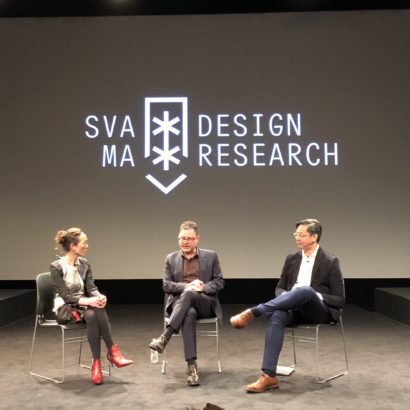
For some weeks, I’ve been working hard to make a spectacular contribution to what I’m sure will be a spectacular discussion panel at this year’s South by Southwest Interactive Festival. It’s called “Traditional Design & New Technology” and it examines the questions of whether and how the aesthetic and functional principles that guided graphic design throughout its pre-Internet existence make sense on the World Wide Web. How do the vastly differing criteria between offline and online media determine what makes for ‘good design’? How has the shifting role of designers affected the expectations that audiences set for design quality? How do changing tools and techniques influence the relevancy of traditional design values?
As far as design topics go, these are some of the thornier ones, at least in my estimation. For this, I have the formidable Mark Boulton to thank — or to blame, as it’s turned out, for all the extracurricular hours we’ve spent preparing for this session. The original brainstorm was his; then he and I did the initial planning together. But the whole affair has come much further than we could have ever hoped thanks to the work of our co-panelists: Jason Santa Maria and Toni Greaves, and our moderator, Liz Danzico.
These people are all very, very impressive, and if I weren’t on this panel, I’d be in the audience just to watch them. For real! I’d even be there at the very early time and date of 10:00a on Saturday morning, 11 March, which just happens to be when “Traditional Design & New Technology” will take place. Yes, that’s the first day and the first time slot in the festival — we’re even on before the opening remarks, if you can believe it. The way I like to look at it: I once went to see Spiritualized open up for The Jesus & Mary Chain in the early nineties: I don’t regret seeing the Mary Chain, but I’m really glad I saw Spiritualized. You’ll be glad too, if you show up for this panel. Hope to see you there.
 This is either the beginning or the middle of a golden age for software, in which, almost literally, any feature set you could want (within reason, of course) is being worked on by somebody somewhere. And if you wait just long enough, exactly such a product will make its debut in the marketplace.
 For some weeks, I’ve been working hard to make a spectacular contribution to what I’m sure will be a spectacular discussion panel at this year’s