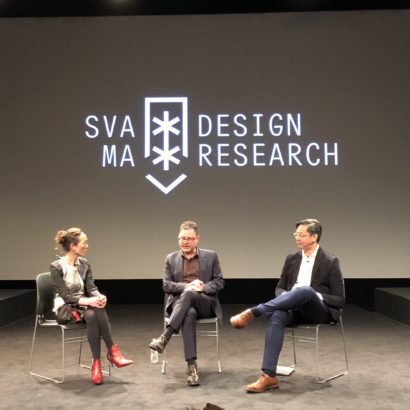
D-Crit Now Accepting Applications for Fall 2010

Ratings

4 of 5 stars
What’s this?

The School of Visual Arts’ MFA in Design Criticism program, run by my friend Alice Twemlow, is gearing up for its second school year starting this autumn. There’s not another program in the country, to my knowledge, that gives students access to a wealth of critical design knowledge on this level:

Create original segments in a radio and podcasting workshop with PRI’s “Studio 360” senior producer Leital Molad and host Kurt Andersen; voyage deep into 20th century design with design historian Russell Flinchum; learn investigative journalism techniques with Change Observer editor Julie Lasky; curate exhibitions with MoMA design curator Paola Antonelli and Cooper Hewitt National Design Museum curator Matilda McQuaid; and find your critical voice with Ralph Caplan, Akiko Busch, and Andrea Codrington.

The core curriculum, which trains students to research, analyze, and evaluate design and its social and environmental implications, is supplemented by the specialist knowledge of more than 40 visiting critics and lecturers per semester. Recent guests include Sam Tanenhaus, editor of The New York Times Book Review, industrial designer Ayse Birsel, documentary filmmaker Gary Huswit, Gawker.com editor-in-chief Gabriel Snyder, New York Times perfume critic Chandler Burr, author and critic Rick Poynor, and Cathy Leff, director of the Wolfsonian Museum.

More about applying here at the D-Crit site. Also you might be interested in my 2008 interview with Alice.

+

Pulling Over and Asking for Directions

All told, I think I did a pretty good job of ignoring “Lost” for years, in spite of all the raves and recommendations from friends. Mostly, it was out of self-interest; I couldn’t afford the time investment that another hugely complicated television series would require, especially one that seemed to inspire such obsessive fandom. But now, living with a “Lost” devotee as I do, I find I can no longer willfully ignore the persistent phenomenon that is J.J. Abrams’ labyrinthine television saga. I started watching a handful of episodes here and there last season, and when the show’s sixth season debuted on Tuesday evening I joined Laura on the couch to take in its latest two hours.

Here’s my assessment so far: it’s a superbly crafted entertainment but it executes itself haphazardly. I find myself easily drawn into its fundamentally strong storytelling tactics, but even after watching the best episodes, the momentum of the series inspires no real confidence that the next installment will be any good.

And, frankly, I don’t really get what’s happening. What is this show about? A time shifting island? A fractious fraternity of metaphysically-challenged losers? A just-in-time catalog of bogus belief systems? I have no idea, really, but to the show’s credit it’s all good enough to keep me thinking about it. Herewith, then, are some random notes from a Viewer New to “Lost”

Continue Reading

+

Notes on iPad

It’s not as if I haven’t had a point of view on all of this tablet computing device stuff that’s been lighting up the Internets for the past several months, but for professional reasons, I’ve had to keep mum. Suffice it to say, I’m really excited about Apple’s iPad, announced today, and I’m even more excited about what can be done with it.

However. I’m pretty sure that I’m in the camp that believes that this is not the salvation that most publishing companies have been looking for. Not that the device falls short in some way, but rather because nothing can save publishing as it’s been operating for the past several decades. The iPad does nothing to change the brutal mandate that has been pushing publishers to change for these many years; if anything it compounds the imperative.

iPad

As a general principle, there’s no way around evolution, and in this specific instance the reality is that there is no direct translation of the print experience to digital media. That is, the content can be translated, but it’s not likely to be as literal as many might expect or even hope. Those looking to the iPad to return us to some semblance of a print-like reading experience are basically wrong, I believe. In fact, lots of really smart people will continue to get this wrong going forward. We’re all still figuring out. That’s the definition of an opportunity.

Continue Reading

+

The New York Rocker

Ratings

2 of 5 stars
What’s this?

A small but excellent selection of covers from “the definitive music and culture publication in New York City in the early 1980s.” I’d never heard of it before, but then in the Eighties New York was just an idea and not a real place for me yet. These covers evoke that dreamland of my youth though: gritty, plausibly if not authentically punk, confrontational and exclusive (who the hell were Human Switchboard? Oh, that’s who).

+

Watching Movies When Not Watching Baby

Since becoming a dad, I’ve been able to go out to the cinema to see just three movies in three months. Luckily, at home, the situation is a little better, thanks to Netflix, Apple TV and the new Blu-Ray player that I got for the holidays. Still a general lack of free time makes it hard to see as many as I’d like, and I feel lucky that I get to see any movies, let alone write about them here on this blog. The days of being able to knock out lengthy reviews of the sort that I once did for, say, last year’s “Public Enemies” or 2008’s (still underrated!) “Speed Racer” seem a long way off now.

I still like writing about movies though, still enjoy articulating my thoughts about them, trying to get at the core ideas in filmed media that matter to me. Whether or not anyone really likes them, or whether the generally design-centric audience for this blog finds anything relevant in them, I’m not sure. But writing about shit you like is one of the perks of having your own blog, so I’m going to keep doing it — when I can. I’m just going to have get used to writing more succinctly, and get over the embarrassment of sometimes only publishing my thoughts long, long after the movies have left the current spotlight. Here are three write-ups to get started.

Continue Reading

+

App.itize.us

Ratings

2 of 5 stars
What’s this?

“A painstakingly curated presentation of the best produced and designed iPhone applications…my goal is for this site to showcase new and emerging talent, current talent and represent the best of the best applications for the iPhone for design-minded folk.”

As the sheer volume of available iPhone apps grows beyond crazy huge into the stratospherically absurd realm, I think we’ll see more and more third-party attempts to make sense of the volume, both through hand-picked methods like this one and other, more automated means.

+

Your Pal, John Kricfalusi

Ratings

5 of 5 stars
What’s this?

One of those heartwarming human interest stories that’s completely invulnerable to cynicism.

“In 1998, aged just 14, aspiring young cartoonist Amir Avni decided to get in touch with the creator of Ren & Stimpy, John Kricfalusi. Being a hardcore fan of Kricfalusi’s work, Amir sent him an introductory letter along with a few cartoons he’d drawn, some of which contained relatively unknown characters of John’s. To call Kricfalusi’s response ‘generous’ would be an understatement…”

The letter itself, hand-written and partly hand-drawn, practically hums with warmth; see it in its entirety here. Also, if you’re not reading Kricfalusi’s blog — even if you’re nothing more than a casual admirer of cartoon animation — then you’re denying yourself regular insights into the mind of true artist.

+